
Butcher Knife vs Chef Knife: Which One Belongs on Your Board?
October 13, 2026 · By Matt
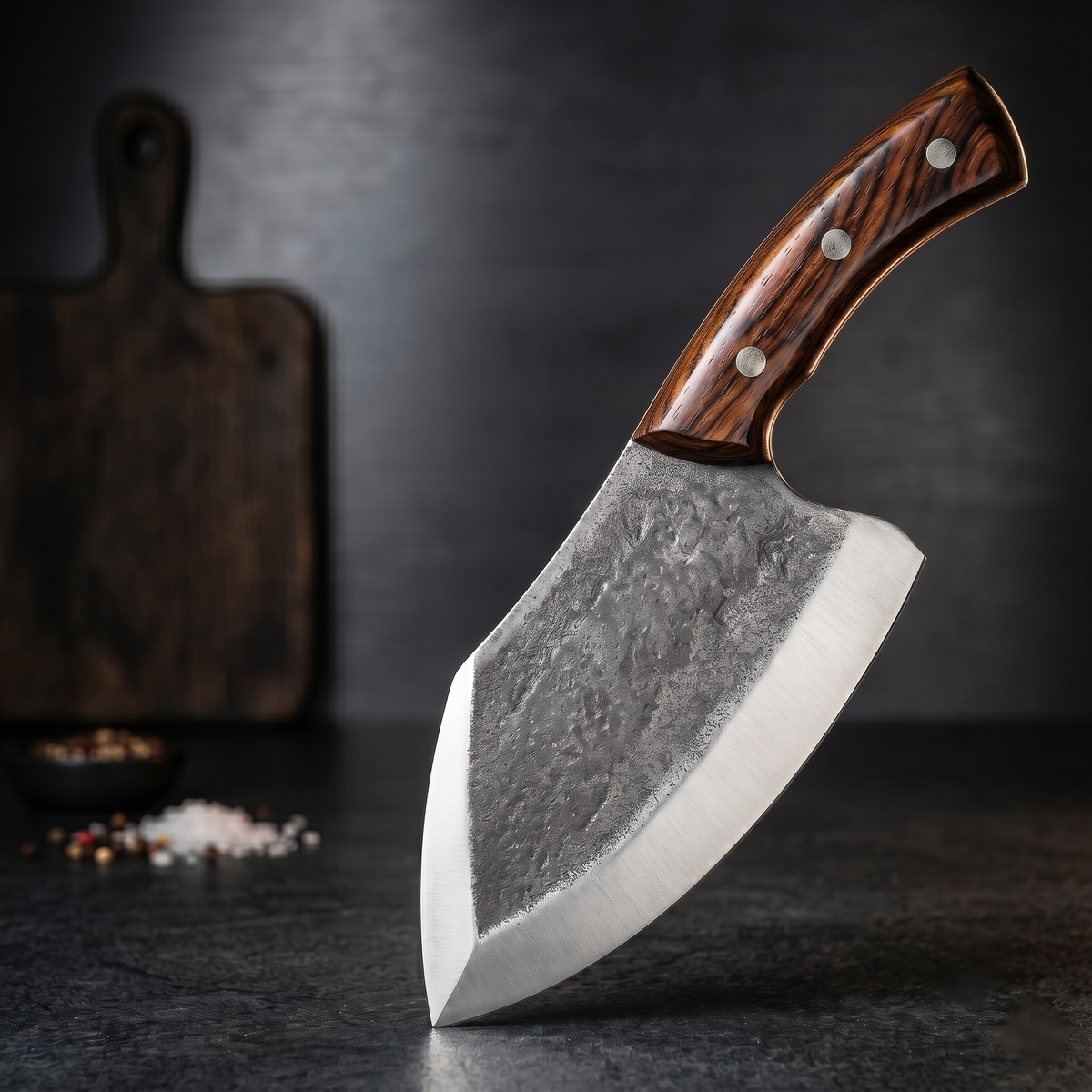
A butcher knife is built for meat: breaking down cuts, trimming fat and silver skin, and on the cleaver end of the family, going through joints and small bone. A chef knife is built for everything else on the board, plus boneless meat, which it handles very well. If you cook a bit of everything, buy the chef knife first. If you buy whole cuts and break them down at home, the butcher knife earns its place next to it.
The two get compared a lot, usually by someone holding one of them over a pork shoulder and wondering if they bought the wrong thing. Mostly they did not. They bought a knife that is good at some jobs and merely willing at others, which describes every knife ever forged. This guide sorts out which jobs belong to which, and which one to buy first.
What Is a Butcher Knife?
Here is the awkward part. Ask three people what a butcher knife looks like and you will get three different drawings. The name covers a family of meat knives rather than one fixed shape. Wikipedia puts the job plainly: a butcher knife is a knife designed and used primarily for the butchering or dressing of animal carcasses, which is a fair summary of everything that follows: Wikipedia on the butcher knife.
The curved breaking knife
In a butcher shop, a breaking knife is a stiff blade with a pronounced upward curve toward the tip. It is used to split large cuts into smaller ones, following seams between muscles and cutting around joints. The curve lets the tip reach into tight spots while the belly does long draw cuts.
The scimitar
A scimitar is the long, sweeping version of the same idea, with a deep curved belly. Butchers use it to slice steaks from a whole loin in one smooth pull. Unless you are cutting steaks from a whole subprimal most weekends, you can admire it from a distance.
The butcher cleaver
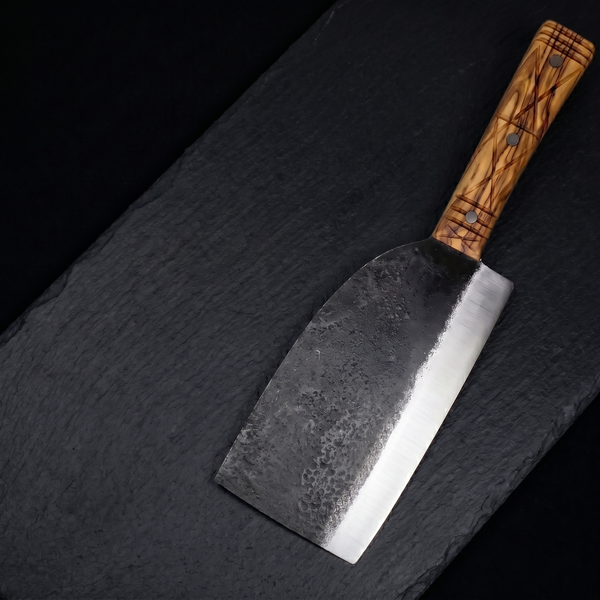
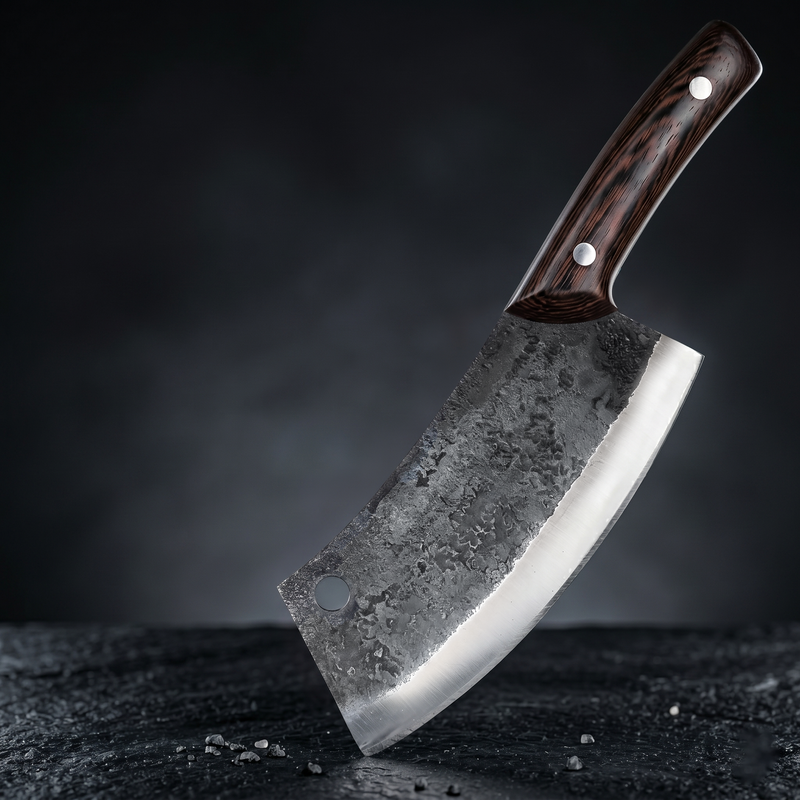
Plenty of home cooks mean a tall, heavy blade when they say butcher knife. That is the butcher cleaver: a broad blade with enough weight to chop through joints and small bones, and a long enough edge to slice meat as well. Our butcher knives collection covers the small trimming end and the cleaver end of this family.
The butcher knives we make
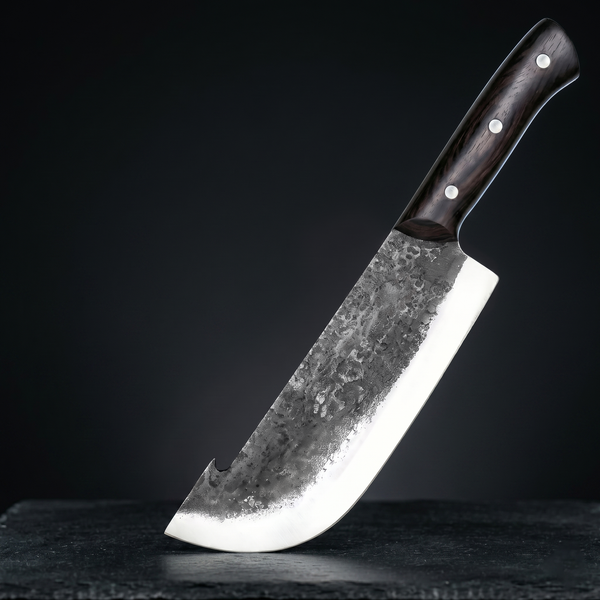
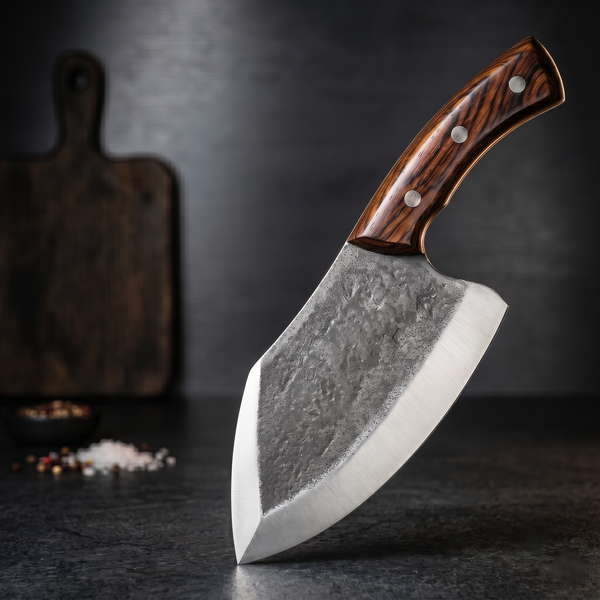
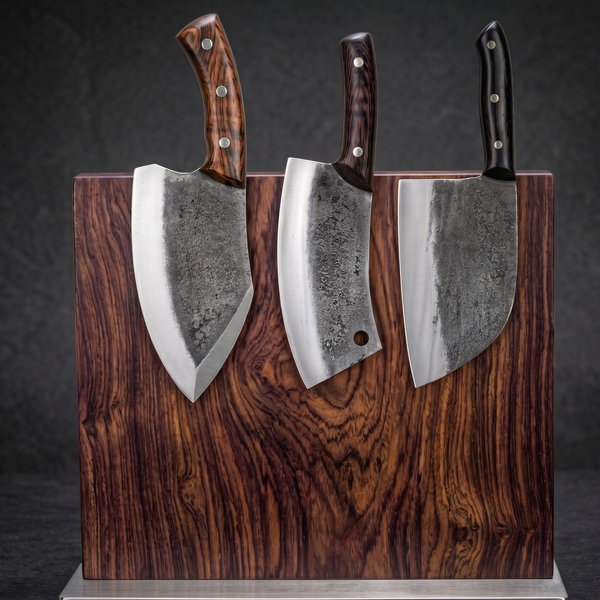
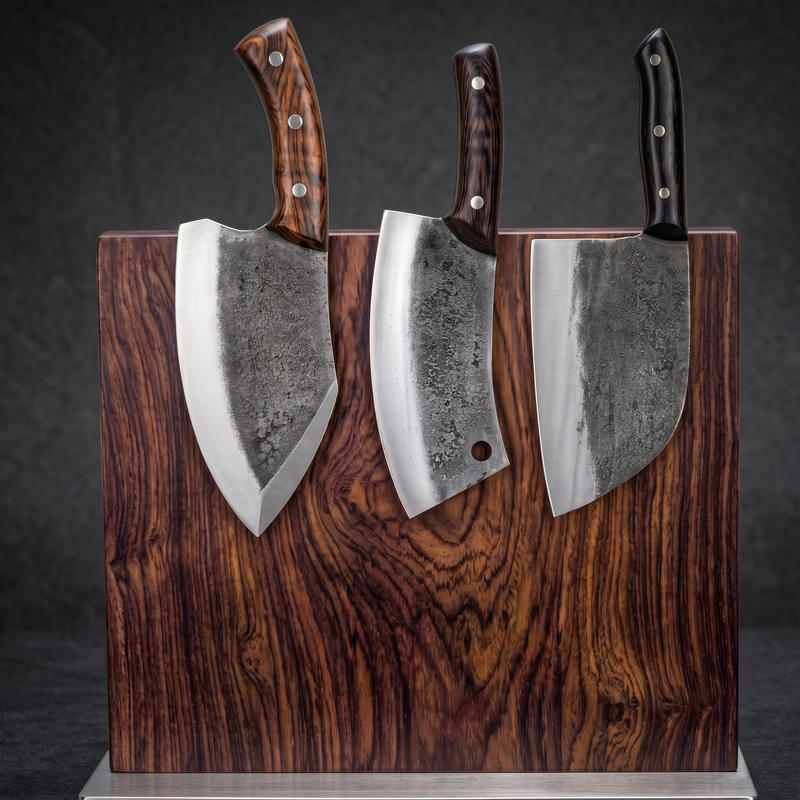
On our side of the counter, there are three. The Hellfang 5" butcher knife is the small one, a meat trimming knife at 240 g with a 5" blade that is easy to steer around fat and sinew. The 7.5" hand forged butcher cleaver sits at the heavy end at 700 g, with a rosewood handle and a blade meant for chopping. The Kodiak 8" butcher cleaver splits the difference at 581 g, with a drop point profile in the Serbian style, so it chops and still slices a roast without a fight. If you want to know where a butcher cleaver ends and a meat cleaver begins, that hair gets split properly in our meat cleaver vs butcher knife guide.
What Is a Chef Knife?
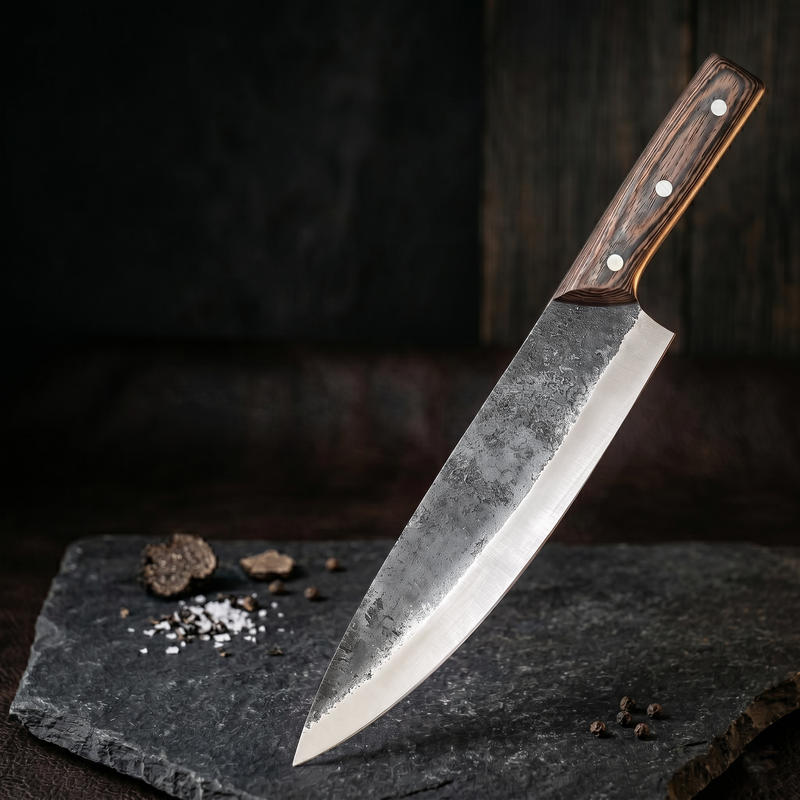
A chef knife is the general purpose knife of the kitchen. It has a pointed tip, a gently curved edge that lets you rock it through herbs, and a blade thin enough behind the edge to fall through an onion instead of wedging in it. Most are somewhere around 7 to 10 inches long. It chops, slices, dices, minces, and it handles boneless meat and fish without complaint. The full list of its jobs is in what a chef knife is used for.
Our chef knives come in two shapes. The classic pointed ones are the Orca 7" chef knife, a light everyday knife at 260 g with a black rosewood handle, and the Ironclad 8.7" chef knife, which gives you a longer edge for big boards and a hand hammered spine, at 330 g.
The Serbian chef knife
Then there are the tall ones. A Serbian chef knife looks like someone crossed a chef knife with a cleaver and refused to apologize. The Kermode 7" chef cleaver has a tall blade with a curved edge that rocks like a chef knife, at 349 g. The Chef's Kiss 7" Serbian chef knife is taller and heavier again at 404 g. Both are still chef knives at heart: they slice, they rock, they scoop food off the board. They are not bone choppers, whatever their silhouette suggests. Call them chef knives with broad shoulders.
How Are They Different?
The short version is that a butcher knife is shaped around meat and a chef knife is shaped around the whole board. The long version comes down to four things.
Blade shape
Butcher blades follow the job. A breaking knife curves up to get around joints, a scimitar curves long for steaks, and a butcher cleaver goes tall and broad. A chef knife keeps a pointed tip and a steady curve from heel to tip, because the same profile has to dice a carrot and slice a chicken breast in the same ten minutes.
Weight
This is where our two families split hardest. The Hellfang is light at 240 g, but the butcher cleavers run 581 g and 700 g. Our classic chef knives sit at 260 g and 330 g. Weight is what drives a cleaver through a joint. It is also what tires your wrist after twenty minutes of dicing onions, which is why nobody preps a salad with a butcher cleaver twice.
Edge
A chef knife is thin behind the edge so it glides. A butcher cleaver keeps more steel behind the edge so it can land on cartilage and come back intact. As general practice, thin kitchen knives are often sharpened somewhere around 15 to 20 degrees per side, and heavy cleavers wider, often around 20 to 25 degrees or more. We do not publish a factory angle for any of our knives, and the honest advice is to match the bevel that is already there. Color the bevel with a marker, make two light strokes on the stone, and see where the ink came off.
Jobs
Butcher knives break down, trim and portion meat. The cleaver versions also take on joints and small bone. A chef knife does vegetables, herbs, fruit, boneless meat and fish, and most of what a recipe means when it says chop.
Butcher Knife vs Chef Knife at a Glance
| Feature | Butcher knife | Chef knife |
|---|---|---|
| Main job | Breaking down, trimming and portioning meat | General prep: vegetables, herbs, boneless meat, fish |
| Common shapes | Curved breaking knife, scimitar, butcher cleaver, small trimming knife | Pointed classic chef knife, tall Serbian chef knife |
| Weight (our range) | 240 g Hellfang, 581 g Kodiak, 700 g butcher cleaver | 260 g Orca, 330 g Ironclad, up to 404 g Chef's Kiss |
| Edge | Sturdier, more steel behind it on the cleaver styles | Thinner behind the edge, built to glide |
| Bone | Butcher cleavers handle joints and small bone | No bone, ever |
| Vegetables | Possible, clumsy over a long session | What it was made for |
| Cutting motion | Draw cuts, trimming, chopping | Rocking, push cuts, slicing |
| Buy first if | You break down whole cuts at home | You cook a bit of everything |
Can a Chef Knife Cut Meat?
Yes, and it does it well, as long as the meat has no bone in it. A sharp chef knife slices chicken breasts, cubes stewing beef, trims a pork loin and cuts a steak into strips for a stir fry. A longer blade like the Ironclad 8.7" helps on a big roast, because a long edge lets you finish the slice in one pull instead of sawing back and forth. If you were searching for a chef knife for cutting meat, that is the honest answer: it already is one.
Where it goes wrong is bone. A chef knife driven into a chicken joint or a chop bone will chip or roll its thin edge, and the same applies to the tall Serbian chef knives, which look sturdy enough to try and will make you regret it. Cut around bones with the tip, or hand the job to a cleaver. And no knife should be chopping frozen meat. It chips the edge, on chef knives and cleavers alike.
Can a Butcher Knife Cut Vegetables?
It can. Whether you want it to is another question. The Hellfang is small and light enough to peel and trim vegetables without fuss, though at 5" it runs out of edge fast on a cabbage. A butcher cleaver will cut through squash, cabbage and sweet potatoes with real authority, and the tall blade is handy for scooping chopped food into a pan. What it will not do comfortably is a long session of fine dicing. The weight that drives the Kodiak through a joint is the same weight your wrist lifts every time you mince garlic. If you want the full argument between a heavy blade and a chef knife on general prep, our cleaver vs chef knife guide makes it.
Which One Should You Buy First?
It depends on how you cook, not on which one looks better on the wall.
You cook a bit of everything
Buy a chef knife. It will do most of what your kitchen asks of it every day, including the meat. The Orca 7" is the light, easy start, and the Ironclad 8.7" suits anyone with a big board and big hands.
You cook mostly meat and buy whole cuts
Buy a butcher knife, and probably a chef knife soon after. If you break down chickens, spatchcock birds, or portion ribs and roasts, the Kodiak or the 7.5" butcher cleaver will save the thin edge on your chef knife from jobs it should never see. For trimming brisket fat and silver skin, the Hellfang is the cheaper and nimbler answer.
You want one knife that leans both ways
Look at a Serbian chef knife. The Kermode or the Chef's Kiss gives you a tall blade that scoops and rocks like a chef knife and has more heft through meat than a classic profile. Just keep it off bone. That is still cleaver territory.
You want the heavy end covered properly
If ribs, joints and thick bones are a regular thing in your kitchen, go straight to the cleavers collection. The Rhino 8" Serbian cleaver is 1250 g with a 0.3" thick blade and is made to order, so allow 2 to 3 weeks before it ships. The Kraken 8" cleaver is lighter at 380 g, with a hammer textured blade and a black wenge handle, and it sits closer to a slicing cleaver than a bone splitter.
Do They Need Different Care?
No. Every knife we make is hand forged high carbon steel with a full tang and steel pins, so the routine is the same for all of them: hand wash, dry it straight away, wipe on a light coat of food safe oil, and keep it out of the dishwasher and out of a soaking sink. A patina will build on the steel over time. That is normal, and it is not rust, however much it looks like the knife has been somewhere interesting. All of them carry a lifetime warranty against defects in materials and craftsmanship, and in stock knives reach the USA and Australia in 5 to 6 business days.
Most kitchens that cook a lot of meat end up owning both, which is not indecision, just division of labour. If the knife you are weighing up is a heavier chopper rather than a butcher knife, read meat cleaver vs butcher knife next, or browse the full range of hand forged cleavers.
Questions
What is the difference between a butcher knife and a chef knife?
A butcher knife is shaped for meat, for breaking down cuts, trimming fat and, on cleaver styles, chopping joints and small bone. A chef knife is a general purpose knife with a pointed tip and a thin edge that handles vegetables, herbs, fish and boneless meat. Most cooks use a chef knife daily and a butcher knife for meat jobs.
Can I use a chef knife for cutting meat?
Yes. A sharp chef knife slices chicken breasts, cubes beef, trims a pork loin and cuts steak into strips with no trouble. Keep it away from bone, because the thin edge will chip or roll. A longer blade such as the Ironclad 8.7 inch helps on big roasts. Never use it on frozen meat.
Can a butcher knife cut vegetables?
It can. A small butcher knife like the Hellfang trims and peels vegetables easily, and a butcher cleaver goes through squash and cabbage with authority. The trouble is long sessions of fine dicing, where the weight of a cleaver tires your wrist. For daily vegetable prep a chef knife is the more comfortable tool.
Should I buy a butcher knife or a chef knife first?
If you cook a bit of everything, buy a chef knife first, because it covers most daily jobs including boneless meat. If you regularly break down whole chickens, ribs or roasts, a butcher knife or butcher cleaver earns its place early and keeps your chef knife away from bone. Many meat heavy kitchens end up owning both.
Is a Serbian chef knife a butcher knife?
No. A Serbian chef knife such as the Kermode or Chef's Kiss has a tall blade that looks like a cleaver, but it is a chef knife at heart. It rocks, slices and scoops food off the board, and it has more heft through meat than a classic chef knife. It should still stay off bone and frozen food.
Shop the knives from this guide
Keep reading
Meat Cleaver vs Butcher Knife: Which One Your Kitchen Needs
A meat cleaver chops through joints and bone with weight and a tough edge. A butcher knife slices, trims and portions with a long,...
Cleaver vs Chef Knife: Which One Do You Actually Need?
Cleaver or chef knife? What each knife is actually for, where the tall Serbian style chef cleaver sits between them, how weight and cutting...
What Is a Chef Knife Used For? Jobs, Sizes and How to Hold One
What a chef knife is used for, and what it should never be asked to do. How to pick a blade length for your...